



















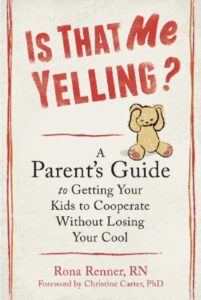
 “Is That Me Yelling? A parents guide to getting your kids to cooperate without losing your cool” was published in 2013 and is available in 5 different languages. It’s a best seller in China, but here in the US you can only get it now on Kindle until the next edition.
If you would like to set up a presentation or training for your child’s preschool or your workplace, you can contact me at .
Is That Me Yelling? is:
“Engaging and practical, humorous and evidence-based, prescriptive but not preachy, authoritative yet never stuffy, Is That Me Yelling? quickly rises to the top of the many parenting books I’ve ever read. Rona Renner provides thoughtful and achievable solutions. If you’re a parent who has ever yelled at your kid and wished you hadn’t, this book is for you.”
—Stephen P. Hinshaw, PhD, professor in the department of psychology at the University of California, Berkeley; and vice-chair of psychology at the University of California, S.F.
“Is That Me Yelling? is a complete and compassionate companion for every parent and educator. With excellent examples from her extensive professional and personal experience, nurse Rona illustrates fundamental psychological principles and functional parenting practices with empathy and enthusiasm.”
—Marisol Muñoz-Kiehne, PhD, clinical psychologist, parent educator, radio host, and author.
Are Today’s Kids Overprotected?

Do you let your elementary school kid walk to school alone? Do you let your nine-year-old play unsupervised at a park? For recent generations of children, play almost always happens in the presence of an adult. But there is growing concern among parents and experts that kids need more freedom to explore the world on their own. We’ll discuss how today’s parents weigh risks and safety concerns for their kids, and what has changed from previous generations
What do you think?
Trainings and Events
May 13th 2015
Join me at Parents Place in Marin from 7-9PM
Do you want to have more harmony at home and less yelling? Most parents agree that yelling isn’t beneficial, but many report that they just don’t know what to do when their children misbehave. Learn to create a plan—and more—to address the issues that trigger yelling. Even if you don’t yell a lot, this class will help you consider new ways to communicate with your child and provide discipline and guidance.
One recent participant said, “Rona’s class goes beyond the standard suggestions of deep breaths and removing yourself from the room. She helped me think about the negative thought patterns I get caught in that fuel my yelling.”
To register for “Is That Me Yelling?” go to:

Do you want to schedule a training for parents, teachers, childcare providers, or health professionals? Let’s talk!
Radio Interviews about Discipline on Pacifica-KPFT in Huston
 On Aug. 28th I had the pleasure of talking with George Reiter on KPFT, the Pacifica station in Huston. George covers progressive and environmental issues on his show, Thresholds, and is interested in talking about discipline and raising children with respect. You can hear my interview about yelling less below.
 Dr. Intisar Shareef also joined George Reiter on Sept. 11th to discuss discipline and the consequences of using harsh physical punishment with children. It was a terrific conversation about her own experience raising foster children, and about the work she does teaching parents, children, and childcare providers.
You can here it below:
Radio Interview on Yelling Less
Linda O’Connor and I discussed how easy it is to yell at kids and what we can do to reduce our reactivity and increase awareness and respectful responses.
Take a listen, and let me know how you reduce your stress and yell less.
Check out Linda’s other interviews: Radio http://timelessweck.com/podcasts/parent-talk.

“Daddy, I can’t sleep!” A middle of the night trigger for yelling!
In my book, “Is That Me Yelling?” I touch on the issue of sleep deprivation as a common trigger for parental yelling during the day, or at 3AM, when you’re not able to be rational or calm.
There are many consequences of too little sleep, such as lack of focus, irritability, poor emotional control, and an overall foggy feeling. Sleep deprivation can also set you up for a lower resistance to fighting off colds and other illnesses. Parents and children frequently feel stressed out, and a good nights sleep is an important element in stress reduction.

Many parents report that when their child gets into the habit of waking up in the middle of the night, they lose it, and start to yell. Yelling rarely helps, and will often make matters worse since a child may get worried or upset, motivating her to want more comfort.
Most couples share the burden of getting up at night to comfort a crying baby or to walk a seven year old back to her bed after her loud howling woke you and perhaps the neighbors as well. And if you’re a single parent, your sanity depends on creative solutions to getting a good night sleep.
What has worked for you, to help your child learn how to put herself back to sleep? Here are some solutions that parents have used. What would you add?
- Walk your child back to bed and help her learn ways to soothe herself back to sleep. Stay calm and in control of your emotions—and with a consistent message over time your child may learn that he can go back to sleep without a parent there.
- Give-in to his desire, and let him sleep with you “just this one night.”
- Put a sleeping bag or mat (not too comfy) on the floor in your room and tell your child she can come and sleep there in the middle of the night, as long as she doesn’t wake you up.
- Teach your child how to do slow easy breathing (maybe with a stuffed animal on her belly) or the body-scan, so she can soothe herself back to sleep. Try an eye pillow that has a soothing lavender scent.
- Get a dog to sleep with your child.
- Try a sound machine. For some kids it does the trick when they stir at night. You may find it useful for trips as well.
- Revisit your child’s bedtime routine. Work to teach your child how to fall asleep at bedtime, on his own—without a parent sitting there until he is asleep. If he gets use to falling asleep without you there, he will be more likely to fall back to sleep without you as well.
- Make sure he has had a good dinner or a bed time healthy snack, so a hungry belly isn’t the cause of waking.
- Talk to your child about her school day and listen to any fears or concerns she has about her school performance or friendships. Worries can keep a child from falling back to sleep. Reflect on the amount of one-on-one time you have with your child.
- Engage your child in a conversation about what would help him get back to sleep without waking you. Experiment with the different ideas if they make sense to you. Let him know that you need your sleep and you don’t want to be woken up at night. Tell him that you will be a much nicer person during the day if you sleep well.
- Do an inventory on the level of stress in the house in the evening. If things are tense between family members, it can impact healthy sleep.
- Don’t have TV or other electronics in your child’s room. Too much visual stimulation, or scary movies, can cause sleep waking. Also the bedroom should be on the cool side, and most people sleep much better in the dark, with the lights out and good curtains to keep the sun from shining into the room in the early morning. Some children do better with a night light, so you’ll need to figure out what’s best.
- Talk to your health care provider to rule out any issues such as sleep apnea or snoring.
Children go through different stages of development. At some stages they become more aware of the world around them, and because of that, they may not feel safe or secure. Many children become more aware and interested in death and dying between the ages of 7-9, and they may temporarily need extra comfort and connection. Behavior has meaning, and at the same time habits get formed easily, so think it though before you bring your child into your bed at night. It’s a personal decision, so decide if that’s what you (and your partner or spouse) want, and if that’s what your child needs. Each family is unique, and so what works for you may be very different than what works for your friend or sister.