


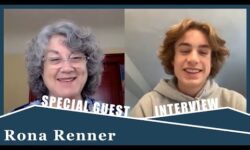
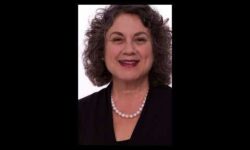

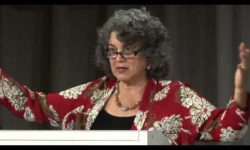
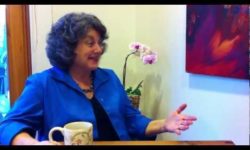
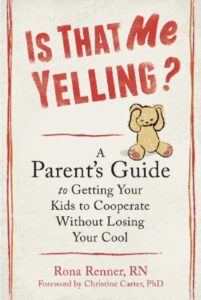
 “Is That Me Yelling? A parents guide to getting your kids to cooperate without losing your cool” was published in 2013 and is available in 5 different languages. It’s a best seller in China, but here in the US you can only get it now on Kindle until the next edition.
If you would like to set up a presentation or training for your child’s preschool or your workplace, you can contact me at .
Is That Me Yelling? is:
“Engaging and practical, humorous and evidence-based, prescriptive but not preachy, authoritative yet never stuffy, Is That Me Yelling? quickly rises to the top of the many parenting books I’ve ever read. Rona Renner provides thoughtful and achievable solutions. If you’re a parent who has ever yelled at your kid and wished you hadn’t, this book is for you.”
—Stephen P. Hinshaw, PhD, professor in the department of psychology at the University of California, Berkeley; and vice-chair of psychology at the University of California, S.F.
“Is That Me Yelling? is a complete and compassionate companion for every parent and educator. With excellent examples from her extensive professional and personal experience, nurse Rona illustrates fundamental psychological principles and functional parenting practices with empathy and enthusiasm.”
—Marisol Muñoz-Kiehne, PhD, clinical psychologist, parent educator, radio host, and author.
Trauma and Resilience
 If you missed the show on @KPFA 94.1FM on Christmas Day (12/25/17) you can listen now: https://kpfa.org/player/?audio=275452
The holiday season can be difficult for people suffering from trauma or post-traumatic stress disorder…better know as PTSD. During this time of year some people try to avoid situations that trigger memories of a traumatic event, or they avoid people they feel uncomfortable around. Sometimes family or friends are involved in a history of trauma, and seeing a specific person can be really challenging. The holidays are “supposed to be joyful” but some people feel alienated for not pretending to be happy. And sometimes a person doesn’t even realize why she’s feeling down around this time of year. It can be really helpful to understand some of the causes that are influencing your emotional state, and also what to do about it.
Guest:
 Rachel Walker received a Masters Degree in Counseling Psychology from the California Institute of Integral Studies, where she specialized in Expressive Arts Therapy. In the past she worked with people with chronic mental illnesses such as schizophrenia, with criminal offenders, and with people suffering from addictions. She has provided individual, couple, and family therapy to clients facing a wide range of clinical issues including: anxiety, trauma, addiction, divorce, grief, bi-polar, cultural and diversity issues, eating disorders and creative and professional blocks. She is trained in modern dance and contact improvisation and Authentic Movement. Rachel has also studied improvisational writing, theater, and voice. Currently she sees clients as an EMDR and Expressive Arts Therapist in Berkeley, California. She is a certified EMDR therapist and approved EMDR consultant. Go to http://rachelwalkermft.com/ to learn more about her work.
Homelessness: A public health crisis

Listen now to our show from 11/27/17, on KPFA.org 94.1FM
https://kpfa.org/archives
Being unhoused makes it difficult, and in some cases impossible, to access general health services. Poor health, addiction, mental illness, and violence are some things that lead to homelessness, and homelessness can make all of these things worse.
The majority of adults that experience homelessness have more than one health issue. They range from hypertension and diabetes to HIV and viral hepatitis, but the most significant reasons people go to emergency-rooms are mental illness and addiction. The sick and vulnerable become homeless, and the homeless become sicker and more vulnerable.
Guests:
 Alejandro Soto-Vigil comes from a family of activists in the Bay Area. Last year he was re-elected to his second term on the Berkeley Rent Stabilization Board. After 8 years working in the City of Berkeley as a legislative aide, Alejandro now serves as the program manager for the Berkeley Drop-In Center, an organization that has served Berkeley’s homeless residents for over 25 years. Alejandro majored in political sciences at UC Berkeley.
 Jeffrey Seal is the medical director and interim director of Alameda County Health Care for the Homeless, as well as an Assistant Clinical Professor in the UCSF Department of Psychiatry. He has worked at the Child Psychiatry Branch of the National Institute of Mental Health. He completed his medical degree at Boston University, a psychiatry residency at UCSF, and a chief residency at San Francisco General Hospital. He grew up on the Gulf Coast of Alabama, and currently lives in Oakland CA. He is a current California Health Care Foundation Leadership fellow and has special interests in public health systems, social determinants of health, re-entry populations, and trauma.
Stroke: Symptoms and Recovery
Listen to About Health’s show from 11/20/17
KPFA.org, 94.1FM
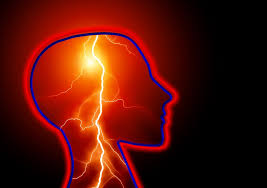
A stroke happens every 40 seconds in the U.S. and is the fifth leading cause of death, killing about 140,000 Americans each year.
The average person loses 1.9 million brain cells every minute a stroke goes untreated. Recovery from a stroke is a life long process, and there are many people, like my guest, Dr. Diane Barnes, who have a story to tell that might help you or a loved one with recovery and hope.
Common Stroke Warning Signs and Symptoms
- Sudden numbness or weakness of the face, arm, or leg—especially on one side of the body.
- Sudden confusion, trouble speaking or understanding.
- Sudden trouble seeing in one or both eyes.
- Sudden trouble walking, dizziness, loss of balance or coordination.
- Sudden severe headache with no known cause.
If you think someone may be having a stroke, act F.A.S.T. and do the following test:
F—Face: Ask the person to smile. Does one side of the face droop?
A—Arms: Ask the person to raise both arms. Does one arm drift downward?
S—Speech: Ask the person to repeat a simple phrase. Is the speech slurred or strange?
T—Time: If you see any of these signs, call 9-1-1 right away.
Guests
 Dr. Diane Barnes is a third generation physician. She is a graduate of Stanford University and Yale University School of Medicine, and is board certified in Diagnostic Radiology. She left the practice of medicine in 2010. After surviving the catastrophe that inspired her one-women show, My Stroke of Luck, Diane Barnes discovered improvisation. Now a Meisner-trained actor, she also completed the American Conservatory Theater’s Summer Training Congress, and studied with Anna Deavere Smith, Ann Randolph, Keith Johnstone, and the Dell’Arte International School of Physical Theatre. You can find out more about her show, presented November 2-December 9, at www.themarsh.org, or call The Marsh box office at 415-282-3055
Patricia Gill, MS, MFT, is the Executive Director at the Schurig Center.
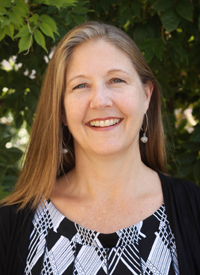 She started there in 2006 as a Teacher/Counselor and transitioned to Programs Director in 2007, and then Executive Director in 2009. Patricia earned a BA and MS in Clinical Psychology from San Francisco State University and has worked in research and clinical positions at UC Davis and UCSF. Other professional positions include management of an Alzheimer’s and Dementia residential program; administration of neuropsychological testing; teaching at the University of San Francisco; coordinating research projects at UCSF/USF; and providing psychotherapy services to individuals, couples, and groups. Patricia is passionate about providing services that enhance people’s lives and ability to meaningfully engage with the community.
Traumatic Brain Injuries: Recovery and Repair

Listen now: https://kpfa.org/player/?audio=271121
Whether you’re a professional athlete, high school soccer player, in the military, a victim of a traffic accident, or an elder who has fallen, a Traumatic Brain Injury (TBI) will change your brain and often your life. At least 3.17 million Americans are living with long-term disabilities related to TBI. An integrative approach is essential to healing.
Dr. Dan Engle was my guest on KPFA.org, 94.1FM, Oct.23 2017, to discuss causes and treatments of TBI’s.
Dr. Dan Engle is a psychiatrist with a clinical practice that combines aspects of regenerative medicine, psychedelic research, integrative spirituality, and peak performance. His medical degree is from the University of Texas at San Antonio. His psychiatry residency degree is from the University of Colorado in Denver, and his child and adolescent psychiatry fellowship degree is from Oregon Health & Science University. Dr. Engle is an international consultant to several global healing centers facilitating the use of long-standing indigenous plant medicines for healing and awakening. He is the Founder and Medical Director of Kuya Institute for Transformational Medicine in Austin, Texas; Full Spectrum Medicine, a psychedelic integration and educational platform; and Thank You Life, a non-profit funding stream supporting access to psychedelic therapies.
Dr. Engle is the author of The Concussion Repair Manual: A Practical Guide to Recovering from Traumatic Brain Injuries, as well as his new book, A Dose of Hope: A Story of MDMA-Assisted Psychotherapy.
Connect with Dr. Dan:
www.drdanengle.com, www.fullspectrummedicine.com, www.kuya.life, www.thankyoulife.org

Sleep Sweet Sleep
Listen now to the show we did on About Health (10/2/17) on KPFA.org
https://kpfa.org/player/?audio=269492
 We discussed the complexities of getting a good night sleep and talked about insomnia, jet lag, circadian rhythms, shift work, electronics, and other sleep concerns.

Healthy adults needed for shift work study!
Research being done at Palo Alto VA: Call 650-849-1971 or email
for more information, or check out the facebook page:
https://www.facebook.com/vapahcs/posts/10153954103298158:0
Guest
 Jamie Zeitzer, PhD, is an Assistant Professor of Psychiatry and Behavioral Sciences at the Stanford Center for Sleep Sciences and Medicine and a health science specialist at the VA Palo Alto Health Care System. He is a member of the Stanford Center on Longevity, Child Health Research Institute, and Stanford Neurosciences Institute. Dr. Zeitzer’s work has direct application in jet lag, shift work, and altered sleep timing in teens and older individuals.